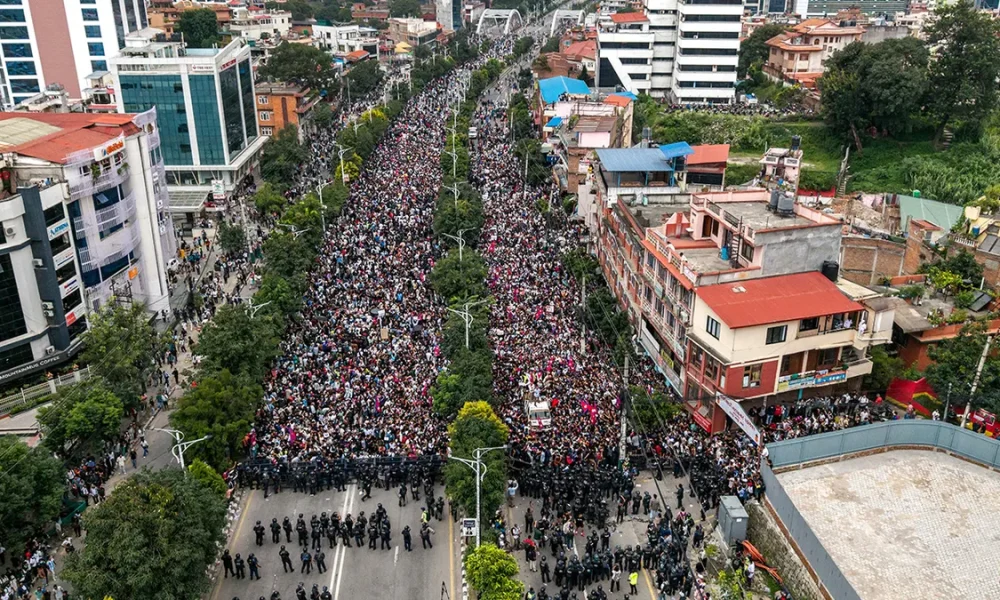
The world witnessed widespread protests in Kathmandu, the capital of Nepal on 9th September 2025. Most Western outlets framed the protests as a surge of exasperation building over the years. The immediate trigger, however, was a government social media ban that abruptly cut off hundreds of thousands of Nepalese expatriates from close contact with families back home. Western media commentary argued social media ban related isolation resulted in outrage, but such assertions were not grounded in systematic research or sentiment analysis. Nepal, where nearly half the population is under 25 (2021 census), has long been prone to youthful unrest. With internet penetration surpassing 50% in 2024, the ban did more than sever communication; it signalled a government out of step with its youngest citizens, writes Professor Dheeraj Sharma, director, Indian Institute of Management-Rohtak.
Comparable findings from developed countries highlight why this rupture mattered: a 2021 Pew Research Center survey in the United States found that young adults reported heightened stress and loneliness during even short social media outages, while Oxford Internet Institute research in Europe shows that Gen Z increasingly regards digital access as a basic social right. Nepal’s protests, therefore, may not be seen as an anomaly, but as part of a broader global pattern in which restrictions on online interaction function as existential provocations for digitally native generations. However, reasons for Nepal protest and its magnitude will likely have more factor than just social media ban.
At the frontline stood Gen Z Nepalese—educated, relatively affluent, and increasingly restless. This wave was driven less by absolute poverty than by a generational crisis of aspiration. Indeed, globally even in OECD countries, many students expect to enter desirable, high-status jobs without expecting to attend university, especially among socially disadvantaged groups (“Students’ career aspirations do not reflect education plans,” OECD, 2025). Simultaneously, the 2024 Deloitte Gen Z & Millennial Survey—spanning 44 countries—documents widespread anxiety about financial futures, uncertainty about career pathways, and a longing for meaningful change. Even where education is accessible, youth unemployment remains a stubborn problem: in 18 OECD countries between 1990-2019, youth unemployment consistently trended much higher than overall unemployment, driven by structural mismatches and inadequate absorptive capacity. In Nepal, a degree no longer promises upward mobility. What stings is not only the lack of jobs, but the sense of blocked potential and stalled ambitions that have been heightened by comparison with youth in other places. Nepalese youth may have expectancy-reality mismatch.
The fallout of the protests was serious. The Prime Minister resigned, dozens were killed, hundreds injured, and property damage ran into billions. The unrest spread so quickly that it exposed the weakness of Nepal’s state capacity. Unlike the democratic movements of 1990 or 2006, this wave had no clear plan or a unifying demand. What stood out was the makeup of the protestors: mostly educated and relatively affluent youth in a country where per capita income is only about $1,300 and youth unemployment is close to 20%. This revolt was less about basic survival than about frustration over blocked opportunities—a volatile mix with lasting consequences.
Six Focus groups—conducted online (US/Canada) and in person (Delhi/Chandigarh)—found that Gen Z led the protests. Participants described this cohort as “more volatile and gullible” than earlier generations (their self-report, not established fact). The same discussions and news reports suggest external forces and party cadres amplified grievances and steered clashes. This reflects a wider South Asian pattern in which expectations rise faster than institutions—an institutional capacity gap. In Nepal, many allege that external forces or/and political actors leveraged youth energy, turning sections of Gen Z into political instruments (proxies) for regime change rather than partners in reform. Social media conditioning—through echo chambers and information cascades—helped convert Gen Z frustration into confrontation. Continuous amplification of issues in social media and lack of outlets to express themselves results in a seething cauldron of frustration.
The focus groups—held online with Nepalese students in the United States and Canada, and in person in Delhi and Chandigarh—converged on four drivers of mobilisation: the insipid nature of youth life in Nepal (self-reported); family disconnect; frustration at the lack of possibilities to achieve aspirational goals; and limited diversity in employment. Taken together, these forces suggest a demographic dividend at risk. More than 30% of citizens are aged between 15 and 29; without credible ladders of advancement, that energy can easily be diverted into street politics. The findings do not claim to be nationally representative, but they illuminate how monotony, alienation, and narrow opportunity structures incubate discontent.
Family breakdown has deepened the crisis. Once anchored in collectivist traditions, Nepal’s intergenerational bonds are fraying. Social media and consumer culture have eroded shared time at home, while unfiltered information now drowns out the steady guidance elders once offered. The result is isolation within families and the loss of structures that previously channelled youthful impatience into constructive goals. Surveys across South Asia confirm this decline in shared family life; in that vacuum, digital feeds—and those who manipulate them—step in. In Nepal, mentorship is scarce, frustrations unchecked, and parental voices increasingly muted by online noise.
Many young urban Nepalese report that their basic needs are met—homes, cars, and televisions exist through prior generational effort—yet the “next level” remains unclear. The absence of higher-order goals breeds stagnation and frustration. In that fog, quests for quick recognition or “glory” become tempting, even when they seldom deliver and is usually without a substantive end-game. Too often, young people end up functioning as pawns in the hands of others—proxies for larger political agendas rather than beneficiaries of the movements they ignite. This psychological vacuum arising from material security without purpose has possibly created fertile ground for volatility in youth. Also, it helps explain why symbolic triggers, such as a digital ban, can spark outsized reactions.
Employment is the pressure point. Opportunities are concentrated in a few cities and, in Nepal, are heavily tourism-centric. Many young people report that though work pays, it does not advance them—and their credentials often remain undervalued. This mirrors patterns seen in OECD countries: according to a 2023 IZA study (“Educational Job Mismatch, Job Satisfaction, On-the-Job Training”), over-educated workers with mismatched roles tend to be less satisfied and more likely to quit unless provided with meaningful training. Across the OECD, youth unemployment remains stubbornly high even when education levels rise, especially for those lacking relevant work experience or networks. Graduates whose jobs do not align with their fields of study consistently report lower wages and diminished job satisfaction—what many describe as a dignity deficit. In England, more than one-third of workers in 2023 reported having more education than their job strictly requires, a rate significantly above the OECD average, underscoring how credentialism and over-qualification are increasingly common even in developed economies. According our analysis, dignity deficit exists in Nepal and there are very limited advancement opportunities for youth. As a consequence, the self-esteem of the typical Nepalese is impact resulting in finding ways to restore it. Violence and streets protest may be a way to gain it.
Digital platforms acted as both lifelines and fault lines. Misinformation and echo chambers magnified private frustrations into collective anger, fostering a victimhood mentality that spilled violently onto Nepal’s streets. Researchers have documented this dynamic elsewhere: a study in the Proceedings of the National Academy of Sciences found that online clusters reinforce rather than challenge beliefs, while Spain’s “Indignados” protests and Brazil’s impeachment debates showed how negative emotions spread faster in echo chambers. Nepal’s unrest followed the same pattern—grievances amplified resulting in the overwhelming of the institutions. Its experience is a warning for India: when digital spaces replace family and institutional guidance, trust erodes and volatility finds its stage.
Lessons for India
The unrest in Nepal, though tragic, offers India both an introspection and a caution. Gen Z’s volatility gets magnified by weak family anchors and overreliance on digital peers—a dynamic India cannot ignore with its own vast youth population. The present urban society demonstrates weaker family ties and heavy reliance on digital medium. In higher educational institutions, the average screen time for the student is upward of 7 hours per day. First, families must be restored as anchors of stability. This requires more than cultural appeals; it demands policy that recognises caregiving as nation-building. Countries such as the US and Canada extend tax credits to families who live together or care for elders, effectively treating household structural stability as a public good. Specifically, the US and Canada give higher standard deduction to those families that have only one working person. India could adapt similar measures by amending the Income Tax Act to acknowledge homemakers’ contribution and incentivise joint family structures by giving tax breaks or higher standard deductions. When families remain intact, frustrations are counselled at home instead of spilling into the streets. In a society is increasing heading towards to accepting wealth as a single unit of measurement for progress, state needs to financially incentives those families that preserve joint family structures.
Second, education must be reimagined as the frontline against misinformation. Nepal’s protests showed how quickly falsehoods spread when schools prioritise rote memorisation over critical thought. India’s system too rewards exam performance above civic responsibility, digital literacy, and conflict resolution. Therefore, changes are necessary. International models offer guidance: Finland has embedded media literacy across its curriculum, while the Council of Europe promotes digital citizenship programmes that teach students to weigh evidence and resist manipulation. If India reforms its curriculum to emphasise analysis, debate, understanding media, and civic sense, it will produce not just test-takers but youth that has exhibit proper citizenship behaviors. These students shall be far less vulnerable to echo chambers and digital falsehoods.
Third, dissent must be channelled without chaos. The protests in Nepal exposed the cost of unmanaged agitation—economic paralysis, infrastructure damage, and institutional strain. Therefore, the key lies allowing managing the protest and silencing of voices, while keeping it civilized. A balanced approach is needed: controlled protest zones may be established to allow the youth to show how dissent can be visible without paralysing cities. Expanding such designated spaces across districts would make protest a regular and constructive feature of democracy rather than a disruptive one. In other words, youth needs to be taught to protest in civil and non-violent way. Youth must have venues and opportunities to express its discontent without being violent or destructive. The point of protest can be driven home in civil and non-violent manner too. Furthermore, journalism must be held to higher standards. In the United States, for example, South Carolina courts issue press credentials that can be revoked if misused, ensuring that access to institutions carries responsibility. India could strengthen provisions of its Information Technology Act and press credential systems to ensure that repeat offenders who knowingly spread falsehoods face consequences, while strengthening the space for legitimate critique. Truth has never been the enemy of democracy; manipulation has been and will be. Free speech thrives only when tethered to responsibility.
Finally, youth engagement remains the decisive frontier. The Nepal protests were not sparked by hunger but by blocked aspirations—degrees that lead nowhere, skills without pathways, and ambitions denied recognition. India faces a similar risk, with millions of graduates entering a labour market that often fails to match their qualifications. Around the world, countries have channelled youthful energy into nation-building. In South Korea and Singapore, compulsory national service has transformed restlessness into civic pride and discipline. India could consider a similar model of compulsory military training or community service, using the interim time period completion of Class 10/11/or 12 examinations beginning of next academic session. Expanding the National Cadet Corps, embedding community service in education, and incentivizing volunteering in conservation, rural development, and entrepreneurship would reinforce this effort. Such measures would not only build resilience but also signal that the state sees its youth as partners in development, not merely as agitators.
India has so far successfully managed youth aspirations but it needs to transform the negative forces that fuel discontent into positivity. That means families absorbing frustration before it spills onto the streets, schools teaching civics, protest spaces channelling dissent without chaos, journalism bound to truth rather than manipulation, youth offered opportunities of service that build dignity, and innovation instead of idleness. Across South Asia, digitally native generations are rising with demands for dignity; India has the chance to show that this fire can renew democracy rather than burn it down. Nepalese protests proved how quickly a generation can topple leaders and shake institutions with no tangle alternatives. After all, despite all the revolutionary tactics, Head of Nepal is still not let by Gen Z. India must continue to prove that the youth brigade can be trusted and engaged to rejuvenate them, their families, and societies. India must continue to treats its youth as partners not let them develop into pawns that fall prey to internal and external divisive forces.
The views expressed are personal. Research assistance for this work was provided by Hrithvik B., Doctoral Student, Indian Institute of Management-Rohtak
Share this article: